New in role
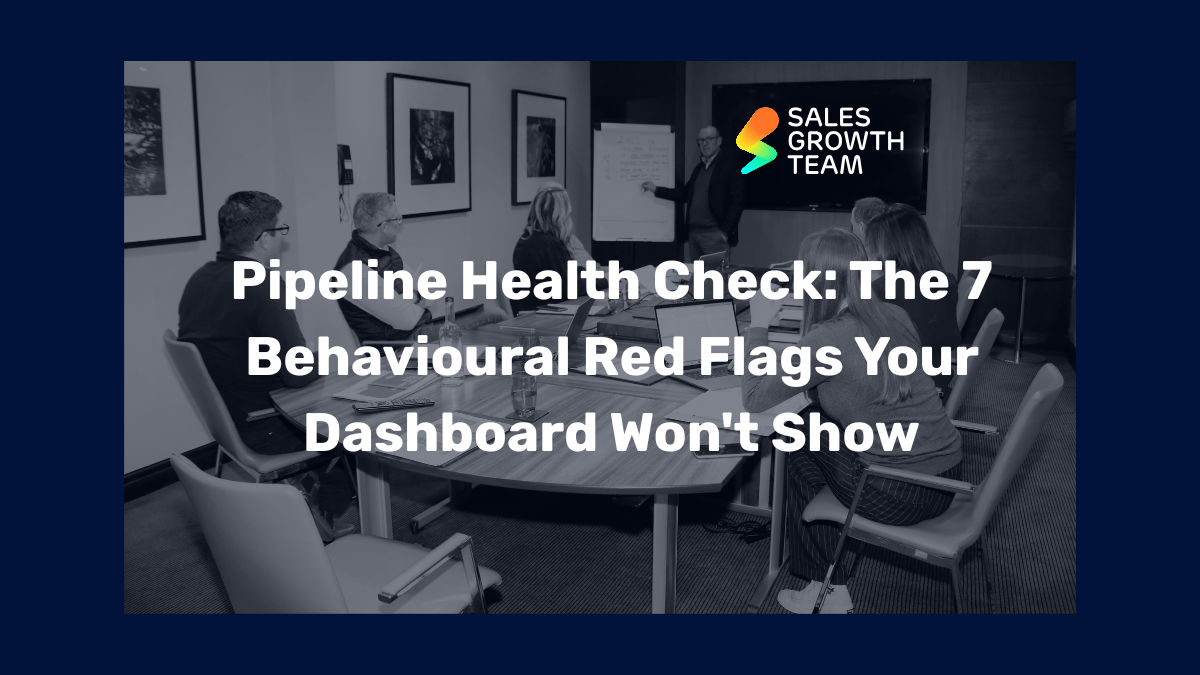

Your pipeline looks healthy on paper. Conversion rates are acceptable. Activity metrics are green. But deals are stalling, forecasts keep slipping, and you can't quite put your finger on why.
Here's the uncomfortable truth: your dashboard shows you what's happening, but it won't tell you why it's happening. The real health of your pipeline isn't visible in Salesforce stages or activity logs, it lives in seller behaviour. And when behaviour reverts to old habits, even the best strategy falls apart.
As a new revenue leader, you're accountable for change. But changing seller behaviour? That's the hardest part of the job. Here are the seven behavioural red flags your dashboard won't surface, and what they're costing you.

Red Flag 1: Sellers Are "Doing the Process" Without Understanding the Customer
What it looks like:
Opportunity stages are being updated. Discovery call notes are logged. But when you listen to calls or review deal strategies, sellers are talking at customers, not with them. They're ticking boxes, not solving problems.
Why it matters:
Customers don't buy from sellers who follow scripts. They buy from sellers who understand their challenges and demonstrate genuine value. When sellers prioritise process compliance over customer insight, deals stall in late stages, and you won't see it coming until the forecast slips.
The hidden cost:
Lower win rates, longer sales cycles, and a pipeline full of "advancing" deals that never close.

Red Flag 2: Manager Coaching Has Become Deal Review Theatre
What it looks like:
Your managers are running weekly pipeline reviews. They're asking questions. But the conversations are all about stage progression and next steps, not about customer challenges, value articulation, or competitive positioning.
Why it matters:
Pipeline reviews aren't coaching. Real coaching digs into how the seller is building customer relationships, positioning value, and managing risk. When managers focus only on forecasting, they miss the opportunity to change behaviour where it matters most: in live deals.
The hidden cost:
Sellers don't develop customer-first instincts. They learn to report progress, not drive outcomes. Your best deals depend on individual heroics, not systematic excellence.
Red Flag 3: New Sellers Are Ramping on War Stories, Not Best Practice
What it looks like:
Onboarding covers product features and sales process. But when new sellers hit the field, they're learning by shadowing whoever is available, absorbing inconsistent approaches, regional quirks, and outdated tactics.
Why it matters:
If your best practice isn't documented, reinforced, and embedded, your team will revert to whatever worked last quarter, or worse, whatever feels comfortable. New sellers deserve clarity, not folklore.
The hidden cost:
Longer ramp times, inconsistent execution across regions, and a culture where "this is how we've always done it" trumps "this is what works."
Red Flag 4: Sellers Are Avoiding Early Engagement
What it looks like:
Deals are entering the pipeline later in the customer's buying journey. Sellers are waiting for RFPs instead of creating demand. They're reacting to inbound interest rather than proactively engaging accounts with intent signals.
Why it matters:
When sellers engage late, they lose control of the narrative. The customer has already defined their requirements, often shaped by competitors. Your team becomes order-takers, not trusted advisors.
The hidden cost:
Commodity pricing pressure, lower average contract values, and a pipeline full of competitive bake-offs where you're playing defence.
Red Flag 5: Cross-Functional Alignment Is a Monthly Meeting, Not a Daily Habit
What it looks like:
Sales, Marketing, and Product meet regularly. Decks get shared. But when sellers are in customer conversations, they're improvising messaging, creating one-off collateral, and working around gaps in the go-to-market engine.
Why it matters:
Customers experience your company as one entity. When Sales is telling a different story than Marketing, or when Product positioning doesn't match what sellers are hearing in the field, trust erodes. Deals slow down. Objections multiply.
The hidden cost:
Longer buying cycles, higher customer acquisition costs, and sellers spending more time on internal coordination than customer engagement.
Red Flag 6: "Determined and Inspired" Is Assumed, Not Assessed
What it looks like:
You've launched a new strategy, rolled out new playbooks, and announced the change. But you haven't baseline-tested whether your sellers are actually ready for it. Are they determined to change? Do they believe in the new direction? Are they equipped to execute it?
Why it matters:
Behaviour change doesn't happen because you announced it. It happens when sellers are Determined, Ready, Inspired, Validated, and Empowered (our D.R.I.V.E. practice). If your team isn't bought in, emotionally and operationally, they'll nod in meetings and revert to old habits in customer calls.
The hidden cost:
Training that fades after workshops. Playbooks that gather digital dust. Revenue targets that slip while you wonder why "the strategy isn't landing."
Red Flag 7: You're Measuring Outcomes, Not Leading Indicators of Behaviour
What it looks like:
Your KPIs track closed deals, pipeline coverage, and win rates. But you're not measuring the behaviours that predict those outcomes: early customer engagement quality, value articulation consistency, or manager coaching effectiveness.
Why it matters:
Outcomes are lagging indicators. By the time your win rate drops, the behaviour that caused it happened weeks or months ago. If you're not tracking the how, you can't course-correct in time.
The hidden cost:
Reactive firefighting instead of proactive performance management. Surprises at quarter-end. A revenue engine that depends on luck, not discipline.
The Reality: Dashboards Don't Change Behaviour—Systems Do
Here's what we've learned from transforming sales teams at scale (including building a $3.8 billion revenue engine and delivering 14 quarters of consecutive double-digit growth):
Changing seller behaviour requires more than training. It requires a system.
You need:
That's the G.E.A.R. Framework, and it's how you move from knowing what to do to actually doing it.
What You Can Do Right Now
If you recognise these red flags in your team, here's where to start:
1. Baseline Your Reality
Don't guess where your sellers are. Assess their propensity and capability for change using a structured readiness framework (we use D.R.I.V.E.). You need the gritty reality before you can build a credible plan.
2. Make Coaching Real
Pipeline reviews aren't coaching. Train your managers to coach on customer challenges, value articulation, and competitive positioning, on live deals, in real time.
3. Embed Best Practice, Don't Just Document It
Playbooks don't change behaviour. Behaviour changes when best practice is reinforced in the field, celebrated in wins, and coached into every deal.
4. Align Your Revenue Engine
Sales, Marketing, and Product must speak the same language to customers. If your messaging is inconsistent, your sellers will improvise, and customers will notice.
5. Track Behaviour, Not Just Outcomes
Identify 3–5 leading indicators of great seller behaviour (early engagement quality, customer-first questioning, manager coaching frequency) and measure them religiously.
The Bottom Line
You can't fix what you can't see. And your dashboard won't show you the behaviour patterns that determine whether your strategy succeeds or fails.
The good news? Behaviour is changeable. But it requires a system, grounded in reality, equipped with practical frameworks, applied on live opportunities, and refined through discipline.
If you're a revenue leader staring at a pipeline that looks fine but feels off, the problem isn't your numbers. It's the behaviours behind them.
Let's talk about what's really happening in your revenue engine, and how to fix it.
Dorp us a DM to discuss your pipeline health and seller readiness.